
The call usually comes within a few days of the accident, sometimes while you are still sore and figuring out how to get to work. The person on the line is polite. They ask how you are doing, they say they want to get this handled quickly, and they ask if they can record the conversation “for accuracy.”
Nothing about that call is unusual, and the adjuster is not doing anything wrong. They work for the insurance company that would pay your claim, and their job is to close the file for what the evidence supports. The company’s interest is to pay as little as it can. What you say in the first week becomes part of that evidence.
Two insurance companies, two different sets of rules
After a car accident in New York, you may hear from two insurers, and the rules for each are different.
The insurer responsible for your No Fault benefits handles that part of the claim. No-fault pays your medical bills and part of your lost earnings no matter who caused the crash, and the policy requires you to cooperate in exchange. That cooperation can include filling out forms, attending a medical examination with a doctor the insurer chooses, and answering questions under oath at an examination under oath. You should cooperate with that insurer, and you can bring a lawyer to an examination under oath.
The other driver’s insurance company is the one that would pay for your pain and suffering and the losses no-fault does not cover. You have no duty to give that company a recorded statement, sign its forms, or answer its questions. Most people do not know that, because the call sounds routine.
If you were a pedestrian or a cyclist, the same split applies. Our page on pedestrian and bicycle accidents explains which policy pays your no-fault benefits.
What a recorded statement is for
A recorded statement fixes your version of events at the moment you know the least. You may not know yet that a disc in your neck is herniated, how long you will be out of work, or what the other driver told the police. Months later, your testimony will be compared line by line against that recording.
Small words matter in these recordings. “I’m okay” said out of politeness gets quoted as proof you were not hurt. “I didn’t see him” can be read as proof you were not paying attention, when you meant the car came out of nowhere. None of this requires anyone to be dishonest. It only requires a recording made before you understood what happened to you.
The questions that cause the most trouble
Most of the questions sound like small talk. These are the ones to be careful with:
- “How are you feeling today?” Many injuries get worse over the first days and weeks. An answer given on day two says nothing about day twenty, but it will be used as if it does.
- “Have you ever hurt your back or neck before?” A prior injury does not end a claim in New York. An aggravated injury is still an injury. A vague answer, or a forgotten old sprain, can later be framed as hiding something.
- “How fast were you going?” Most people guess. A guess on tape becomes a number the insurer can hold you to.
- “Did you see the other car before the crash?” Both yes and no can be used against you, depending on the rest of the story.
- “Were you on your phone?” Answer this one to your lawyer first, so it is answered accurately and completely.
The early check and the release
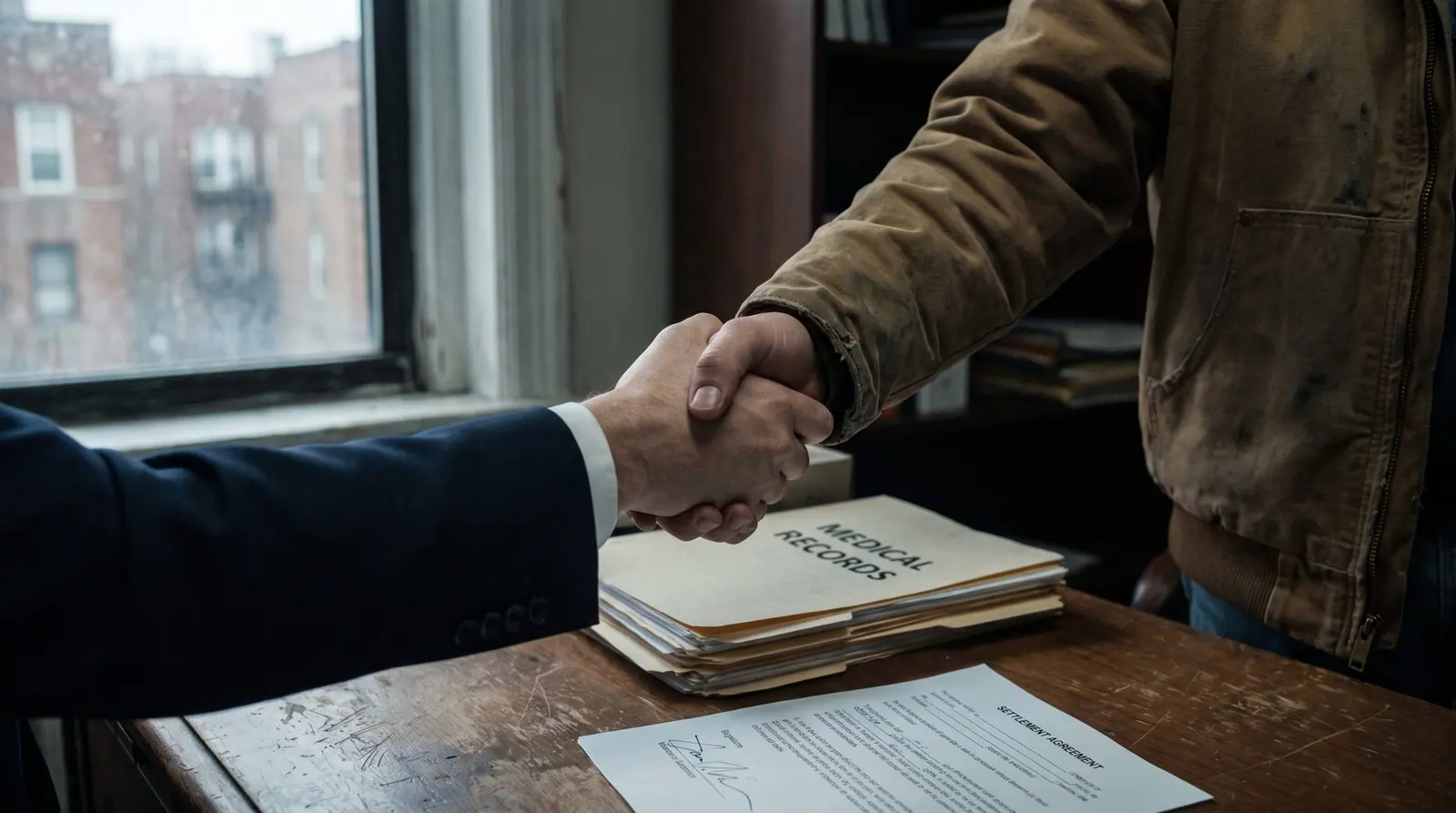
Sometimes the adjuster offers money in the first weeks. The offer often arrives before your doctors know the full extent of your injuries, and it comes with a release. A general release ends the claim for good. If your shoulder needs surgery three months later, the release still stands.
Do not sign anything from the other driver’s insurer until you know how badly you are hurt and what your medical care will cost. There is no benefit to settling before you know what you are settling.
The medical authorization
The other driver’s insurer may send a form asking you to authorize the release of your medical records. These forms are often written broadly enough to cover your entire medical history, including treatment that has nothing to do with this accident. The records the insurer is entitled to see can be exchanged later, through your lawyer, with limits that fit your case. You do not have to sign a blank authorization now.
What to say instead
You do not have to be rude, and you do not have to explain yourself. Give your name and contact information, confirm your own insurance company’s name if asked, and then say:
“I’m not giving a recorded statement. Please send any questions in writing.”
If you have a lawyer, add: “My lawyer will contact you.” Then end the call. The adjuster hears this every day and will not be surprised.
Keep your social media quiet while the claim is open
Insurance companies look at public social media. A photo from a cousin’s birthday, posted on a good day, can be presented as proof that you were fine. Set your accounts to private, do not post about the accident or your injuries, and ask family members not to tag you in photos while the case is open.
If you already gave a statement
It happens, and it does not end your case. Write down what you remember saying while it is fresh, and tell your lawyer. New York law lets you get a copy of any statement you gave (CPLR 3101(e)), so your lawyer can see exactly what the insurer has and plan around it.
A short checklist for the first week
- Get medical care, and tell your doctor about every symptom.
- File your no-fault application with the insurer responsible for your No Fault benefits within 30 days of the accident.
- Cooperate with that insurer. Decline a recorded statement to the other driver’s insurer.
- Do not sign a release or a medical authorization from the other driver’s insurer.
- Keep your social media private and quiet.
- Keep every letter and write down the name of everyone who calls you.
If you were hurt in a crash in Queens or anywhere in New York City, our page on car and truck accidents explains the rest of the process, from no-fault benefits to the claim against the driver who caused it. If an insurance company has already called you, we are glad to talk it through, and the consultation is free.
Common questions
01Do I have to give the other driver’s insurance company a recorded statement?
No. You have no legal duty to give a statement to the other driver’s insurer. You can decline politely and ask them to put any questions in writing.
02Do I have to cooperate with the No Fault insurer?
Yes, if you want No Fault benefits. The No Fault policy requires you to cooperate with the claim, which can include an examination under oath and medical examinations by doctors the insurer chooses. A lawyer can attend the examination under oath with you.
03I already gave a recorded statement. Is my case ruined?
No. Tell your lawyer what you remember saying. New York law lets you get a copy of any statement you gave (CPLR 3101(e)), so your lawyer can see exactly what the insurer has.
This guide explains New York law in general terms and was last reviewed on September 18, 2026. It is not legal advice about your situation. For that, ask us directly.

Eduard Yadgarov, Esq.
Eduard “Eddie” Yadgarov is the founder and principal attorney of EY Legal PLLC in Rego Park, Queens. He earned his J.D. at St. John’s University School of Law and has practiced since 2017. Clients have direct access to their attorney and our team throughout the case.
More about Eddie