

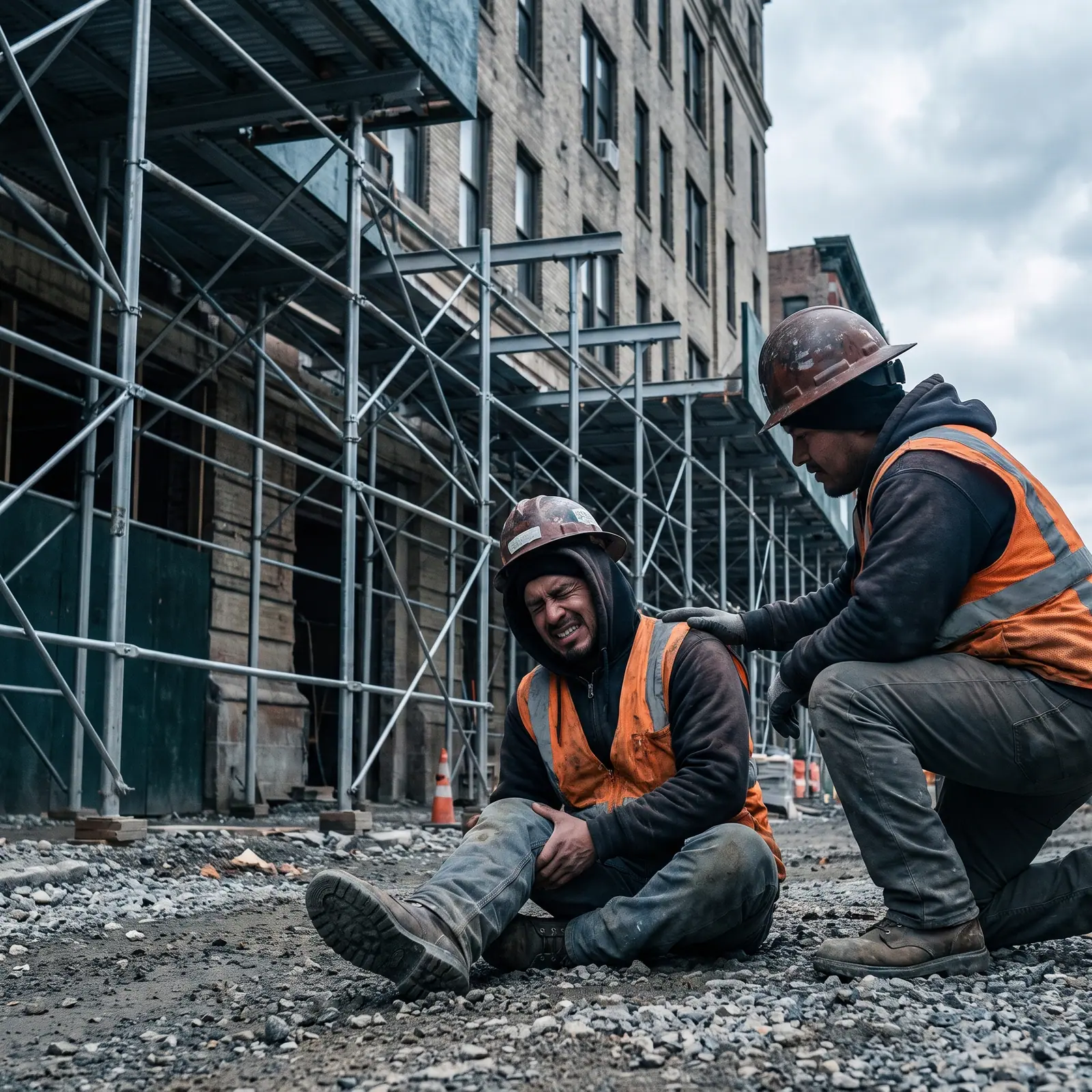
Construction is one of the few kinds of work where New York law puts responsibility for safety squarely on the owners and contractors who run the job. If you were hurt on a site in Queens or anywhere in the state, you may have a claim against them in addition to workers’ compensation, and the Labor Law makes some of those claims hard for them to defend.
You may have two claims
Workers’ compensation comes from your employer’s insurance, whether or not anyone was at fault. Workers’ Compensation pays medical care and can pay a portion of your lost wages, with the amount depending on your wages, disability, and applicable benefit limits. It does not compensate you for pain and suffering. In most cases it is also the only claim you can bring against your own employer (Workers’ Compensation Law §11).
A Labor Law claim goes against the property owner, the general contractor, and sometimes other companies on the site. A separate Labor Law claim may allow recovery for pain and suffering, additional lost earnings, and other damages not fully covered by Workers’ Compensation.
The two claims run side by side. Bringing a Labor Law case does not cost you your workers’ compensation benefits, although the compensation carrier may have a lien on part of the recovery.
Labor Law §240(1), the Scaffold Law
Section 240(1) covers injuries caused by the effects of gravity: a worker falling from a height, or an object falling on a worker. It requires owners and contractors to provide proper protection, such as scaffolds, ladders, hoists, harnesses, braces and slings, and it makes them responsible when missing or inadequate protection causes an injury.
Two features make the Scaffold Law unusual:
- The owner and general contractor can be responsible even if they did not supervise the work or know about the danger. The statute excepts owners of one- and two-family dwellings who contract for the work but do not direct or control it.
- Your own carelessness does not reduce your recovery. The defense wins only if it proves you were the sole cause of the accident, for example by ignoring a safe ladder that was right there and choosing an unsafe one.
Typical Scaffold Law cases include a ladder that slid or collapsed, a scaffold without guardrails, a fall through an unprotected floor opening or roof edge, and materials that fell because they were not hoisted or secured properly.
Labor Law §241(6) and the Industrial Code
Section 241(6) can apply to construction, demolition, and excavation accidents when a specific New York Industrial Code safety rule was violated. Your case has to point to the rule (12 NYCRR Part 23) that was broken. Examples include:
- Slipping hazards such as ice, water or grease left on floors, platforms and walkways (§23-1.7(d))
- Tripping hazards such as debris, scattered tools and loose materials in passageways (§23-1.7(e))
- Ladders that were defective, not secured or used the wrong way (§23-1.21)
- Scaffold requirements in Subpart 23-5
A slip or trip on a sidewalk, in a store or in an apartment building follows different rules, which we cover on our slip and fall page.
Under §241(6), the owner and contractor are responsible for a violation even if a subcontractor caused it. Unlike the Scaffold Law, your own share of fault can reduce the recovery.
Labor Law §200 and general negligence
Section 200 restates the general duty of owners and contractors to keep the workplace safe. It applies when the company controlled the way the work was done, or when it created a dangerous condition or knew about one and left it in place. Many cases plead §200 alongside §240(1) and §241(6), because the three sections cover different facts.
Who can be responsible on a construction site
A single job can involve many companies, and the Labor Law reaches several of them:
- The property owner, in most cases even one that hired others to do all the work and never visited the site. Owners of one- and two-family dwellings who do not direct or control the work are excepted
- The general contractor, which runs the job and is responsible for safety across it
- A construction manager that acted as the owner’s agent and had authority over safety
- Subcontractors that controlled the area or the work where you were hurt
- Manufacturers of a ladder, scaffold, hoist or tool that failed because of a defect
Your employer usually stays out of the lawsuit because of workers’ compensation. The other companies on the site do not get that protection, and each one carries its own liability insurance. The contracts between them decide which company and which insurer pays in the end, and we obtain those contracts early.
Accidents that lead to Labor Law claims
- Falls from ladders, scaffolds, roofs and stairwells, and through floor openings
- Being struck by materials being hoisted, lowered or stacked overhead
- Trench and excavation collapses
- Hoist, elevator shaft and crane accidents
- Slips on ice, water or debris on a work surface
- Electrical injuries from exposed or improperly protected wiring
Your immigration status does not bar a claim
Some workers hesitate to report an injury because of their immigration status. New York’s highest court addressed this directly in Balbuena v. IDR Realty (2006) and held that undocumented workers can bring Labor Law claims and recover lost wages. What you tell a lawyer is protected by attorney-client confidentiality. You can speak with our office in English, Spanish or Russian.
Deadlines after a construction accident
Report the injury within 30 days. Tell your employer in writing within 30 days (Workers’ Compensation Law §18), even if you think it will heal on its own. File your claim with the Workers’ Compensation Board within two years.
The lawsuit against the owner and contractor generally has to be filed within three years of the accident (CPLR 214). If the site was a City of New York or other public project, a notice of claim may be due within 90 days.
What to do after a site accident
- Get medical care and tell every doctor the injury happened at work.
- Report the accident to your foreman and your employer in writing, and keep a copy.
- Write down the names of the general contractor and the property owner. In New York City, the Department of Buildings permit posted at the site names the contractor, and the permit record online lists the owner.
- Photograph the ladder, scaffold, opening or area where you were hurt, before it is fixed or removed.
- Get the names and phone numbers of coworkers who saw the accident.
- Do not sign statements for an insurance company before speaking with a lawyer.
- Keep your pay stubs and records of the hours you worked.
What we collect while you recover
A construction case is built from records the companies control. We gather the Department of Buildings permits and complaints for the site, safety logs, incident reports, and the contracts that show who hired whom and who was responsible for safety. We also talk to coworkers while they are still on the job and remember what happened.
You have direct access to your attorney and our team throughout your case. We coordinate the Labor Law case with your workers’ compensation claim, so the two fit together, and you pay no fee unless we recover money for you. If a construction accident took the life of someone in your family, see our page on wrongful death claims.