

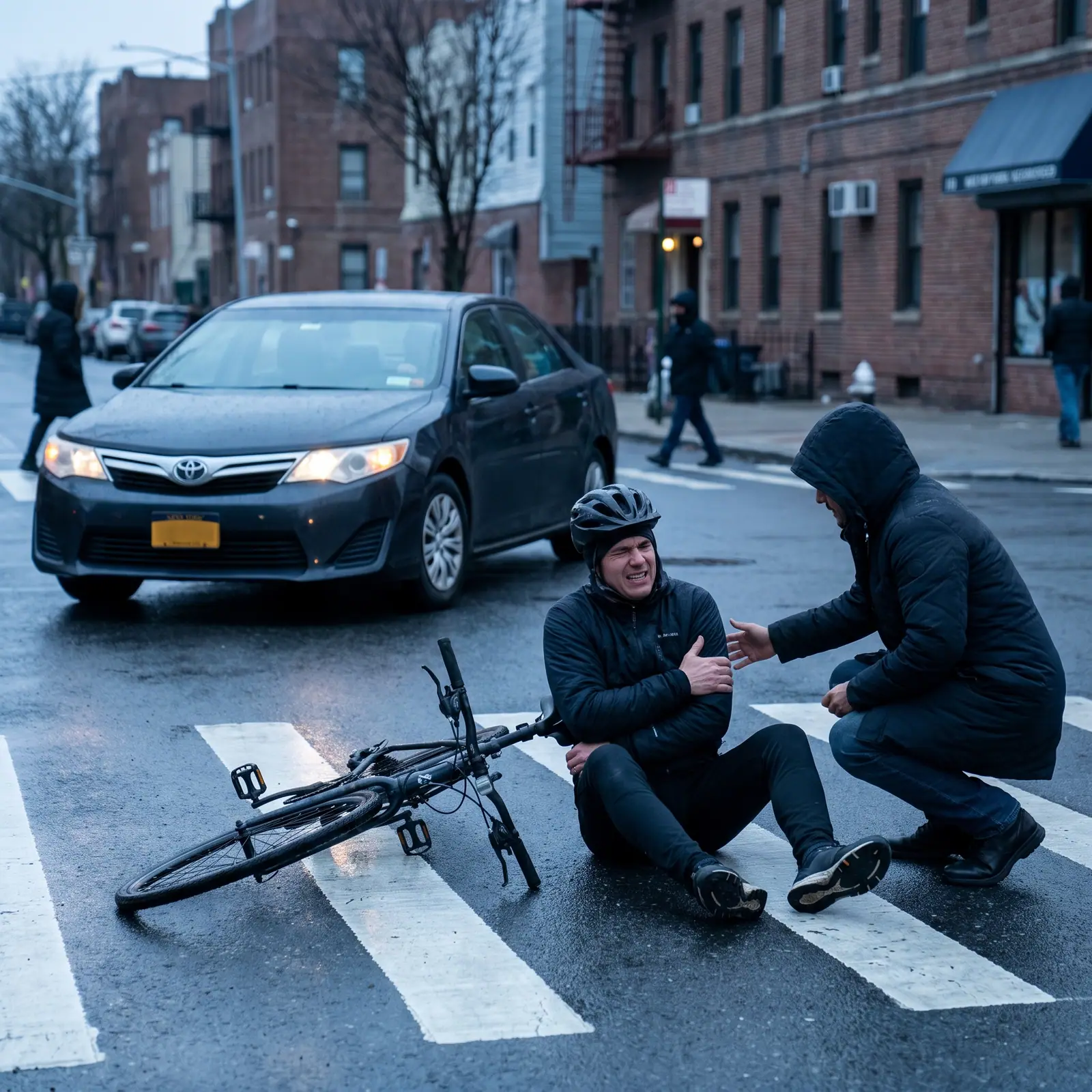
When a car hits someone on foot or on a bike, there is no metal around them to take the force. The injuries are often fractures, head injuries and torn ligaments, and recovery can take months. New York law gives pedestrians and cyclists the same no-fault benefits as people inside the car, plus the right to sue the driver for the rest of their losses.
No-fault covers you even though you weren’t in a car
New York’s no-fault law treats a pedestrian or cyclist hurt by a car as a covered person (Insurance Law §5102). That means your medical bills, 80 percent of your lost earnings up to $2,000 a month, and some everyday expenses are paid regardless of who caused the crash, up to $50,000.
If you were struck as a pedestrian in New York, you generally file your No Fault claim with the insurer of the vehicle that struck you. Different rules can apply if the vehicle was uninsured or cannot be identified.
File within 30 days. The no-fault application has to reach the right insurer within 30 days of the accident. When it is unclear which policy should pay, file with each insurer that might owe benefits, so the deadline is met whichever one it turns out to be.
Right of way in New York City
Most pedestrian cases turn on who had the right of way, and the Vehicle and Traffic Law gives pedestrians a lot of it.
- Drivers must use due care to avoid colliding with any pedestrian or bicyclist, anywhere on the road (VTL §1146).
- At a crosswalk without a traffic signal, drivers must yield to pedestrians crossing in it (VTL §1151).
- When the light is green, drivers turning across a crosswalk must still yield to people walking in it (VTL §1111).
In New York City, the Right of Way Law (Administrative Code §19-190) goes further. A driver who fails to yield to a pedestrian or cyclist who has the right of way, and injures them, can be charged with a crime. A criminal charge is separate from your injury claim, and your claim does not depend on whether the police charge the driver.
Crossing outside a crosswalk or against the signal does not end a case. If you were partly at fault, you may still have a claim. For motor vehicle injury cases commenced on or after May 26, 2026, CPLR 1411(b) generally allows recovery when your share of fault is not greater than the combined fault of the parties you are claiming against. Any recovery is reduced by your percentage of fault. A driver who was speeding, looking at a phone or turning without looking still answers for their part.
Cyclists: dooring, bike lanes and turning vehicles
Cyclists face crashes that pedestrians rarely do. Some of the most common:
- Dooring. No one may open a car door into traffic unless it is reasonably safe to do so (VTL §1214). A driver or passenger who swings a door into a bike lane is responsible for the crash that follows.
- Right hooks. A car or truck passes a cyclist, then turns right across the cyclist’s path. The turning driver has the duty to check and yield.
- Blocked bike lanes. A double-parked car forces a cyclist into traffic, where another vehicle hits them. More than one driver can share responsibility.
E-bikes and e-scooters have been legal in New York since 2020. Riding one does not take away your claim against a driver who hit you, although which policy pays your medical bills can work differently than it does for a pedestrian.
The serious injury rule still applies
To recover for pain and suffering after being hit by a car, you have to meet the same “serious injury” threshold as a driver (Insurance Law §5102(d)). A fracture meets it by itself, and so do a permanent or significant limitation of use and significant disfigurement.
Head injuries deserve particular attention. A concussion may not show on a CT scan, and symptoms like headaches, trouble concentrating and sensitivity to light can appear days later. Tell your doctors about every one of them so they end up in your records.
Evidence in a pedestrian or bicycle case
The driver usually tells the police their version first, often while you are being treated. That makes independent evidence important:
- Video from storefronts, apartment buildings, doorbell cameras and buses
- The 911 call and the police accident report
- Names and phone numbers of witnesses
- Photographs of the car’s damage, which can show where and how hard you were hit
- Your clothing, shoes, helmet and bicycle, kept exactly as they were after the crash
Businesses decide for themselves how long to keep their video, and many record over it on a rolling basis. We send preservation requests as soon as we are hired, before footage can be erased.
When the vehicle belongs to the City or the MTA
If an MTA bus, a sanitation truck, a police car or another City vehicle hit you, the claim follows public-entity rules. A notice of claim has to be served within 90 days of the accident (General Municipal Law §50-e). The lawsuit has to be filed within one year and 90 days. The City can also question you under oath before the case moves forward.
A late notice needs a court’s permission, and the court does not have to give it, so call us well before the 90 days run out.
What to do if a car hits you
- Call 911 and get checked at the scene or at an emergency room the same day.
- Get the driver’s name, license, plate number and insurance card, or ask someone nearby to write them down for you.
- Photograph the street, the crosswalk, the traffic signal, the car and your injuries.
- Keep your clothes, shoes and helmet as they were. If you were on a bike or scooter, do not repair it yet.
- Write down the names and numbers of witnesses.
- Note any cameras on nearby buildings, buses or cars.
- Do not give a recorded statement to the driver’s insurance company.
- File your no-fault application within 30 days, or have us file it.
What we collect while you recover
Recovery after being hit by a car often means surgery, physical therapy and weeks away from work. While you focus on that, we gather the police report, the video, the 911 call and witness statements, and we handle the no-fault filings and every call from the insurance companies.
We serve pedestrians and cyclists across Queens, from Rego Park and Forest Hills to Flushing, Elmhurst and Jackson Heights, and throughout New York City. You have direct access to your attorney and our team throughout your case, you can speak with our office in English, Spanish or Russian, and you pay no fee unless we recover money for you. If you were hurt inside a car instead, see our car and truck accident page. If a pedestrian or cycling crash took the life of someone in your family, see our page on wrongful death claims.