

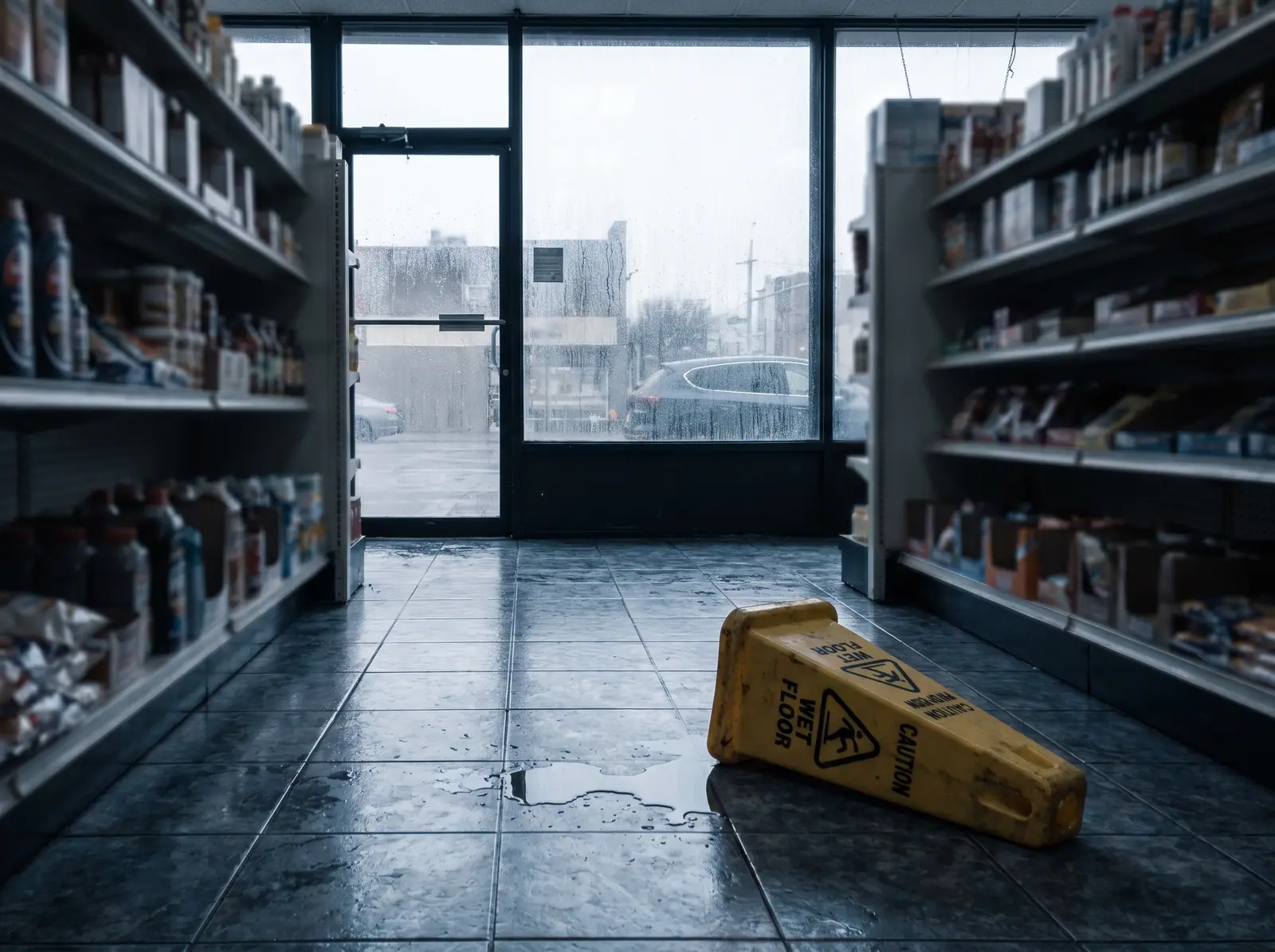
A fall can break a wrist, a hip or an ankle, or cause a head injury, in less than a second. Whether the property owner has to pay for it depends on what caused the fall and what the owner knew. New York law does not make owners responsible for every accident on their property. It makes them responsible for dangerous conditions they created, or knew about, or should have found and fixed.
What you have to prove
A slip and fall claim in New York rests on three questions:
- Was there a dangerous condition? A spill, a broken step, a hole in the sidewalk, a loose mat, ice, poor lighting on a stairway.
- Did the owner create it or know about it? The owner is responsible if its employees caused the hazard, if someone reported it, or if it was visible and had been there long enough that a reasonable inspection would have found it. New York courts call the last one constructive notice, and the standard comes from the Court of Appeals decision in Gordon v. American Museum of Natural History (1986).
- Did it cause your fall and your injuries? Medical records and a clear account of how you fell connect the two.
The second question is where most cases are won or lost. Evidence of how long the hazard was there makes the difference: a spill with cart tracks through it, a dirty or dried edge on a puddle, a repair complaint filed weeks before your fall, or video showing the spot before you arrived.
Sidewalks and streets in New York City
Under NYC Administrative Code §7-210, the owner of a property is responsible for keeping the sidewalk in front of it in reasonably safe condition. That covers cracked and raised slabs, holes, broken curbs and uneven flags. The City stays responsible for sidewalks in front of one-, two- and three-family homes that are owner-occupied and used only as residences. If a vehicle hit you on the sidewalk, that is a different claim, covered on our pedestrian and bicycle page.
Streets are different. A claim against the City for a pothole or another defect in the roadway generally requires proof that the City had prior written notice of the defect and did not repair it within 15 days (Administrative Code §7-201). Maps filed with the Department of Transportation by the Big Apple Pothole and Sidewalk Protection Committee are the usual source of that notice, so we search them early.
Ice and snow
Owners are generally not responsible for a fall that happens while a storm is still in progress. Once the storm ends, they have a reasonable time to clear ice and snow. New York City gives a specific deadline for sidewalks: four hours after the snow stops falling, not counting the hours between 9 p.m. and 7 a.m. (Administrative Code §16-123).
A claim is stronger when the fall happened after that window, on ice that formed from a leaking gutter or a drain the owner ignored, or on a patch that was shoveled badly and left to refreeze. Weather records for the day of the fall often decide these cases, and we obtain them.
Stairs, lighting and apartment buildings
Landlords in New York City have a legal duty to keep their buildings in good repair (Multiple Dwelling Law §78). That includes stairs, handrails, hallway lighting, entrance steps and common areas. Falls in apartment buildings often involve:
- Broken or worn stair treads, or loose handrails
- Burned-out lights in hallways and stairwells
- Water on lobby floors from leaks or mopping without warning signs
- Torn carpeting and loose floor tiles
Complaints to the landlord and violations recorded by the Department of Housing Preservation and Development can show that the owner knew about the problem.
Stores, supermarkets and restaurants
A store has to keep its aisles reasonably safe for customers. Falls in stores usually involve spilled liquid, fallen produce, freshly mopped floors without a warning sign, or merchandise left in the aisle. Stores often keep cleaning or inspection logs, and many have cameras over their aisles.
If you fall in a store, ask the manager to write an incident report and get a copy or at least the manager’s name. Stores control their own video, so we send a preservation letter as soon as we are hired.
Falls on City, NYCHA and transit property
Falls on subway stairs and platforms, in NYCHA buildings, and on other City property follow public-entity rules. You must serve a notice of claim within 90 days of the fall, and the lawsuit has to be filed within one year and 90 days. The agency can also question you under oath before the case goes further. For most private property, the deadline to sue is three years (CPLR 214).
Injuries from falls, and why the serious injury rule does not apply
Falls cause fractured wrists, hips, ankles and kneecaps, torn knee and shoulder ligaments, back injuries and head injuries. A fall is harder on an older adult, where a hip fracture can mean surgery, weeks in rehabilitation and a long loss of independence.
Car crash cases have to meet New York’s “serious injury” threshold before the injured person can recover for pain and suffering. That threshold comes from the no-fault law and applies only to motor vehicle cases. A slip and fall claim does not have to clear it, so a fall that causes a painful injury without a fracture can still support a full claim.
If you were partly at fault
Insurance companies often argue that the person who fell should have been watching the ground. New York’s comparative fault rule (CPLR 1411) reduces your recovery by your share of fault instead of barring it. A hazard that was hard to see, a store display that pulled your attention, or a dim stairway all bear on how fault is divided.
What to do right after a fall
- Get medical care and tell the doctor exactly how you fell.
- Photograph the hazard from close up and from a distance before anyone cleans or repairs it.
- Report the fall to the owner, manager or superintendent, and write down their name.
- Get the names and phone numbers of witnesses.
- Keep the shoes and clothes you were wearing, unwashed and unrepaired.
- Write down the date, time, weather and exactly where you fell.
- Do not give a recorded statement to the owner’s insurer before speaking with a lawyer.
What we collect while you recover
We gather the photographs, video, incident reports, repair records, 311 complaints and building violations that show what the owner knew and when. We handle every call from the insurance companies, and we work with your doctors to document how the fall has affected your life and your work.
You have direct access to your attorney and our team throughout your case, you can speak with our office in English, Spanish or Russian, and you pay no fee unless we recover money for you. If you were hurt on a construction site instead, see our construction accident page.